Introduction
Over a number of decades, maintenance management has grown to see many forms of computerised maintenance management systems (CMMS) with sophisticated features embedded. To many industries these features are seen as essential for competitive edge in the current global business environment.
On the other hand, there are still businesses with manual or spreadsheet based maintenance management systems. Current industrial evolution is flying far forward from such less productive practices.
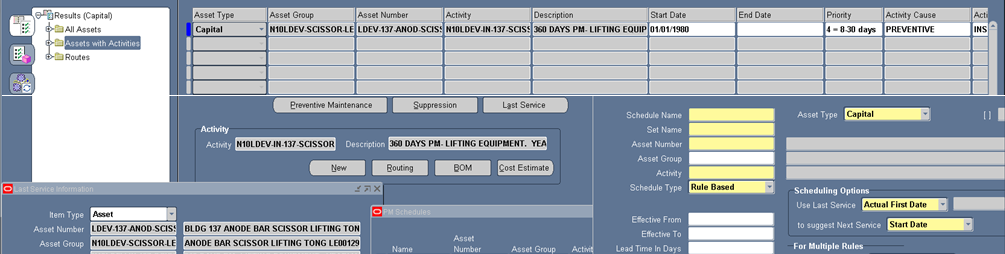
Our focus on this article is to appraise the value of using a CMMS or enterprise asset management (eAM) system – not to inform on much of functionalities (capabilities – what the system does) and usabilities (how easy to use a function).
Measure of CMMS/eAM Value
A tool should be able to provide an enhanced effectiveness and/or efficiency for an organisation, team or an individual. If not, it is worthless. The value of CMMS is viewed as an enabler of asset management or maintenance effectiveness and efficiency boost.
A CMMS tool does not itself enhance effectiveness and efficiency. It must be used by an organisation in a particular manner to harvest that value.
Maintenance effectiveness [do the right things]
Maintenance effectiveness is how well maintenance ensures that assets are continued to function with required level of performance as per designed purpose in a given context.
Maintenance efficiency [do things right]
Maintenance efficiency is how well maintenance resources are being utilised.
What are foundational capabilities of a CMMS?
The following capabilities are required even by a small organisation to perform and add value to maintenance activities.
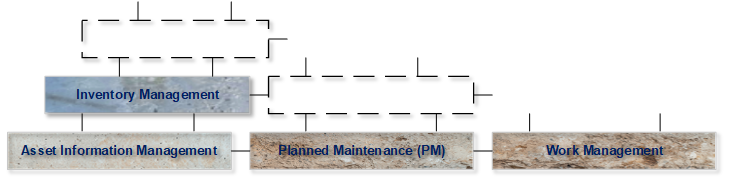
Asset information management: Locations, systems, assets, identifications, hierarchies-structures, criticalities, failure codes, asset value, bill of materials, OEM manuals, etc.
Planned maintenance (PM): Master PM program, asset maintenance tactics, maintenance plans, inspection and condition monitoring routes, predictive maintenance data capture, meters, SOPs, etc.
Work management: Work order generation, work planning & scheduling, work execution recording & closing, reporting on past work history, service (work) requests, etc.
Note: A CMMS or eAM does not manage assets, instead they manage asset information.
What are other capabilities of a CMMS?
Though inventory management (spares, consumables, etc.) is an essential capability of a CMMS, it is intentionally left without considering it as foundational, since many companies treat it that way. Including inventory management, almost all other features and capabilities enhance maintenance effectiveness and efficiency.
They are:
- Linear and fleet asset management
- Procurement management – purchase requests, POs, invoicing, etc.
- Contract & contractor management – contractor setup, etc.
- Simultaneous access by multiple users
- Telematics – live feedback systems of asset conditions through sensors
- Stores & spares – stores requisitions
- Backlog and forward-log management
- Work requests
- Work load scheduler and load balancing
- Geo locations and regions
- Tools register
- Crew time sheets
- Pre-start meeting support
- Connects to other IT systems
Supporting maintenance effectiveness
Effectiveness through asset information management
Visualize, you have a CMMS which does not support accurate and structured asset information. Or you don't have a CMMS at all. In this case, you are in a mess, not having suitable information to make decisions, at least to decide which equipment needs maintenance. So, asset functional performance is not preserved.
A CMMS allows organizations to set up assets in a hierarchical structure with parent-child relationships. This hierarchical structure makes it easier to find and group assets data. Asset lifecycle tracking has become an increasingly important issue for organizations. The lack of visibility, accurate and timely updates of asset data leads to unnecessary purchases of equipment-tools-spares, high asset carrying costs, high working capital, and excessive regulatory fines. It is imperative for companies to know the exact number of the existing assets, their current value, location and maintenance history. Without this vital information, it is challenging to properly plan, perform maintenance activities, procure or construct and deploy assets.
Effectiveness through planned maintenance (PM)
Imagine, you have an eAM, which does not support the appropriate level of maintenance plans. Or you don't have a CMMS at all. So, you can't decide which maintenance to perform for an equipment. Suppose you may have done it before, but now no records. There is no standard set PM task which is repeatable. The asset will suffer breakdowns since, no maintenance done at all, timely or done inaccurately.
Maintenance teams can move their activities from reactive to proactive using early triggered work orders from the eAM. This is equally applicable for regulatory compliance inspections and calibrations too. A CMMS can enhance accuracy of maintenance works performed by providing accurate past information and current asset conditions. By automating planned maintenance triggers, failure modes are prevented entering equipment systems. Eventually this leads to downtime reduction and minimising accumulated operating stress which in turn extend or sustain the asset life, improve reliability and uptime. Thus, it can help defer capital spending for new asset replacements.
Effectiveness through work management
Work management capability is a main outcome of asset information management and planned maintenance.
Picture that your CMMS is incapable of providing the right level of support for work order generation for the next few days, weeks, months or years. This keeps you in a reactive mode and you can't provide tomorrow's work order today to your maintenance crew. It is obvious that all resources must be organised in-rush, minimal to no preparation – no scope, all "fire-fighting", inaccurate-inadequate work execution and unsafe work; in turn the operation will suffer with unplanned breakdowns, downtimes and risky incidents. Tackling an unplanned breakdown will be a true hassle. This is a wasteful context which comprises too much FAT, rather LEAN.
In maintenance planning and scheduling; work scoping, timely scheduling, manning/resourcing and man hours loading are imperative.
The future work forecast gives a capability of estimating all resources required for works and their cost and risks. Work planning and scheduling lead well organised, resourced, timely, accurate and safe work execution of routine, shutdown and campaign type maintenance activities. This can assist to develop a budget portion for planned maintenance activities. Any comments/notes from completed works are recorded for immediate and future reference.
So that the history is captured and can be used for work effectiveness evaluation, asset performance review and tracking, workmanship accountability transparency and potential anticipation of future works as well as further learnings. Standard and/or customised reports from the CMMS show how well assets are maintained and managed by your organisation against whatever performance matrix is set. Also, such data sets can be used for equipment defect elimination programs, loss accounting (revenue-opportunity-profit) and continuous improvement of asset management and systems availability. When assets are approaching the end of economic life, the same goes for supporting better business case development for CAPEX works for renewal, upgrade or replacement.
A service (work) request is made to inform an additional work is required to maintain something. It is converted to a work order (if approved/accepted) and a written record is kept in the system for future reference.

So far, we attempted to realise the effectiveness side of the value of CMMS, using the foundational capabilities only.
Next, we will explore the efficiency part of the value.
Supporting maintenance efficiency
Efficiency through asset information management
CMMSs replace manual and paper-based systems, they allow all relevant stakeholders to access information, identify assets and their interactive relations, criticalities, failure codes, BOMs, manuals, etc. This allows efficient data gathering, analysing and decision making, which require minimal resources, efforts and time.
CMMS can consolidate all assets and work data in one platform making it a single source of truth and decisions can be drawn faster.
Though we have considered only the maintenance work management process, for simplicity, there are many associated processes, namely, inventory-rotable-insurance spares management, procurement, health & safety, backlog & forward-log, support equipment, contracts, etc. A CMMS can streamline these processes having appropriate data and information.
Efficiency through planned maintenance (PM)
Again, with planned maintenance capability of CMMS, the organisation can efficiently develop and set up maintenance tactics and plans in various types, but in standard formats. They can be easily further refined and improved as learnings are captured. They are well driven by targeted failure modes and based on risk minimisation to the operation. So that optimised maintenance is planned rather over or under maintenance, this in turn supports efficient maintenance. With such consistency; asset performance, risks and cost (budget) can be managed with much more predictability. Future predictability is demanded by not just business executives, but by maintenance technicians as well. Here, if it is more predictable, then it is more efficient to play the known maintenance game, by all relevant stakeholders.
Another capability of CMMS is PM route building to group many assets into one maintenance plan and cost can still be allocated to individual assets. It covers the whole asset group in the most productive path, safely. Sharply, this enables optimised resources, efforts and time for particular set of assets maintenance.
Efficiency through work management
A CMMS allows communicating work intent easily, planning and scheduling, executing work, closing out and performance reviewing with less direction, supervision, assistance and involvement from others. Optimal labour and other resources are used for all above activities with minimal waste. Required work scopes and plans can be easily adjusted and updated to suit changing circumstances.
Using a CMMS, work history can be captured and reported with less resources, efforts and time. They can be easily retrieved from the work history. Valuable actual events can be found readily from past work orders' information. Performance of assets and asset management can be tracked easily for prompt decision making to further refine maintenance efficiency. Such decision making is well done and visible across the organisation.
On top of above discussed planning and scheduling elements, in shutdowns and campaigns (in oil & gas industry), the sequencing of tasks (as a project manager) is vital to achieve efficiency of maintenance. Some niche CMMSs support this requirement, and may be combined with project management software application.

Collectively, the above discussion shows the value of CMMS, regardless of the size of the business.
Can JUFANDO support realising the VALUE of CMMS?
Yes, JUFANDO can support any size enterprise to implement CMMS. It could be, you have a clean sheet situation with no CMMS at all, have something not fit-for-purpose or haven't employed the full capabilities of your CMMS.
The question is not "what is available in the (CMMS) market?", it is "what does my organisation want?" to continuously improve value for the business.
We work with your teams to assess what capabilities are really required for your organisation. Then recommend accordingly what works for your business flows with vendor neutral stance, and project manage to implement - establish it.
Such project management may include:
- ✔ The CMMS is implemented and established
- ✔ Configured and validated
- ✔ Training is provided
- ✔ Access authorisation levels are set-up