Introduction
The terms "Design for Sustainability" and "Design for Environment (DfE)" are interchangeably used. They are the same practice with a unique goal for a better world. Nonetheless, "Design for Sustainability (DfS)" and "Design for Safety (DfS)" are not same, but share some attributes. To avoid confusion with "Design for Safety (DfS)", we use the term "Design for Environment (DfE)". DfE is applicable to any man-built systems, processes and products and not limited to plastic products.
What is Design for Environment?
Design for Environment (DfE) is a systematic way of incorporating environmental attributes into the design of a product.
While we are aware that comprehensive consideration is required for any product DfE, here we mainly focus on plastic products DfE. Furthermore, we don't consider plastic material extraction. In plastic product design, we start with material selection through product design to disposal as our scoped lifecycle.
DfE in product design involves production of products, packaging and other auxiliaries that minimise ecological impact throughout their lifecycle.
Why does it matter?
Value of Design for Environment (DfE) is multi-fold including following key benefits.
- Improved environmental performance - Decreased pollution, minimise micro-plastics in the environment, reduced natural resource consumption, and lower carbon footprints lead to reduced ozone depletion, global warming and human health concerns.
- Reduced costs and time-to-market - By designing out hazardous materials, the manufacturer can reduce time-to-market by avoiding the time and resources required to obtain necessary permits. Cost savings through material reduction.
- Improved market position - Meeting growing consumer demand for sustainable, high-quality, and long-lasting products. Enhanced brand reputation. Increased product innovation.
- Reduced regulatory concerns and future liability – By taking a proactive approach to environmental responsibility, manufacturers may be able to position themselves ahead of those companies with reactive strategies. They will avoid future cost and risk of reworking on old designs for regulatory compliance. By eliminating toxic materials from products or designing products that are easily recyclable, companies may avoid significant costs required to dispose of the product.
Initiatives
All modern businesses are accountable to observe and act with sustainable practices for current and future generations to come. There are several national and international initiatives, conventions and goals to follow.
- UN Sustainable Development Goals (SDGs):
- SDG 12: Focuses directly on reducing waste and improving resource efficiency through sustainable management.
- SDG 13: Urges urgent action to combat climate change.
- Regulatory and Framework Drivers:
- Circular Australia (EDCA): A national strategy aimed at adopting eco-design for a circular economy.
- ISO Standards: ISO 14001 and other standards provide a structured approach to environmental management systems (EMS), enabling businesses to monitor and minimize environmental impact.
- The Global Commitment (Plastic Packaging)
This is a major initiative uniting businesses and governments under a common vision for a circular economy for plastics.
- 2025 Targets: Signatories commit to eliminating problematic plastic packaging, moving from single-use to reuse models, and ensuring 100% of plastic packaging is reusable, recyclable, or compostable.
- 2030 Agenda: Signatories are re-committing to a 2030 Plastics Agenda, focusing on reducing virgin plastic use and increasing recycled content.
How to Achieve DfE?
Key principles of Design for Environment (DfE) are:
- The entire life-cycle of a product is considered.
- Point of application is early in the product realization process.
- Decisions are made using a set of values consistent with industrial ecology, integrative systems thinking or similar framework.
The below picture illustrates the life cycle of a manufactured product and circularity (circular economy) approach.
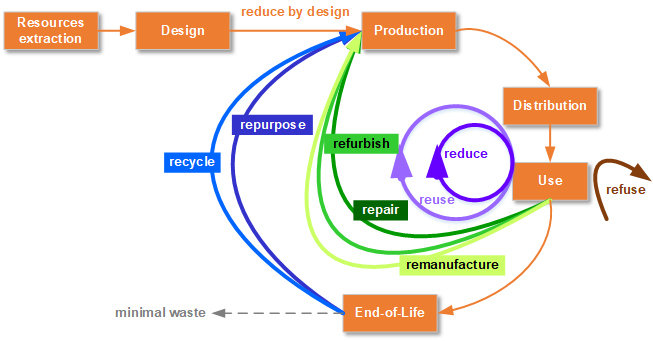
**Distribution must be considered to account for ecological impact of packaging and other auxiliary product materials.
Implementing DfE – Framework
Context - A manufacturer should examine the context in which to implement the DfE program considering internal and external business drivers.
Leadership - It is important that commitments to DfE be made by top management and members throughout the company before implementing the design and production procedures. Establishing specific goals for the company and outlining methods for achieving them enables a manufacturer to assign specific responsibilities to departments and individuals.
Continuous Improvement - Companies that value DfE, it should include methods to monitor application of DfE concepts, track results, and reward improvements to product design. Regular monitoring, reviewing, and adjustments are required. The company needs to establish the momentum of DfE, and ensures to "close the loop". This assures continuous improvement.
Implementing DfE – Approaches
- Incremental product change
- Process improvement
- New product concepts
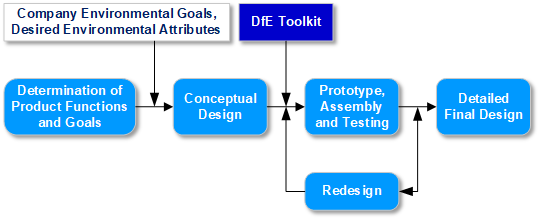
Seven (7) Strategies to DfE
Strategy 1 – New Concept Development
This strategy includes dematerialisation (smaller, lighter products or immaterial substitutes), increase shared use and providing a service.
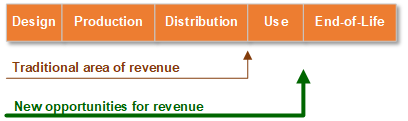
A service model offers companies an opportunity to generate revenue during a product's use and end-of-life phases.
Strategy 2 – Physical Optimisation
The strategy includes integrating and optimising product functions, increasing reliability and durability, facilitating easy maintenance and repair, modular product structure and facilitating stronger user-product relationships.
Strategy 3 – Optimise Material Use
Strategy 3 includes use of cleaner (nonhazardous, nontoxic) materials, renewable materials, lower "embodies energy" materials, recycled materials, recyclable materials and reduce material usage.
An example
Sandwich Injection Moulding—recycled plastics are injected as the bulky core of thick-walled plastic products and new plastic is used only for the outer skin.
Strategy 4 – Optimise Production Techniques
This strategy includes alternative production techniques, fewer production steps, lower/cleaner energy consumption, less production waste and fewer /cleaner production consumables.
Strategy 5 – Optimise Distribution System
The strategy includes less/cleaner/re-usable packaging, energy-efficient transport modes and energy efficient logistics.
Strategy 6 – Reduce Impact During Use
Strategy 6 includes lower energy consumption, cleaner energy sources, reduce use of consumables, cleaner consumables and auxiliary products and reduce energy and other consumable waste.
Strategy 7 – Optimise End-of-Life Systems
This strategy includes reuse of product, design for disassembly (DfDA), product remanufacturing, material recycling and safer incineration.
An example
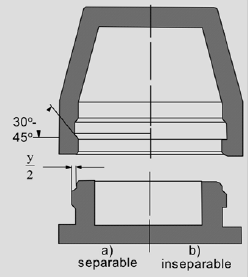
Table 1: Recyclable Plastics
| Type | Plastic | Resin ID Code | Technical recyclability (to date) |
|---|---|---|---|
| Thermoplastics | Polyethylene Terephthalate (PET) | #1 | Yes. |
| High-Density Polyethylene (HDPE) | #2 | Yes. | |
| Polyvinyl Chloride (PVC) | #3 | Yes. Bust special methods are required for safe recycling due to toxic gases emission. Some countries and jurisdictions don't allow them into recycling bins. | |
| Low-Density Polyethylene (LDPE) | #4 | Yes. But needs special recycling plants to avoid tangle with machine parts. Some countries and jurisdictions don't allow them into recycling bins. | |
| Polypropylene (PP) | #5 | Yes. | |
| Polystyrene (PS) | #6 | Yes. Some countries and jurisdictions don't allow them into recycling bins, due to still developing methods. | |
| Others including polycarbonate, LEXAN and bioplastics | #7 | No to partial. Developments are underway for others, including engineering and advanced plastics. Some of bioplastics are biodegradable, while only some are recyclable. | |
| Thermosets | Unsaturated polyester (UP) | N/A | Commonly, thermosets are not recyclable. Researches are underway for new methods and processes to break down chemical cross links/bonds in order to recycle them. |
| Polyurethane (PU) | N/A | ||
| Epoxide (EP) | N/A | ||
| Phenolic resins (phenoplasts) | N/A |
How JUFANDO Supports DfE?
JUFANDO provides DfE consulting services across the product lifecycle, from early planning to end-of-life strategy implementation. For small and medium-sized enterprises (SME), DfE often appears to be too time-consuming and expensive to implement. The aim is to overcome such apparent difficulties with a systemised and prioritised approach.
Our services include:
- Work with your internal teams to develop a solid DfE framework/system.
- Conduct a gap analysis to identify current drawbacks compared to best practices and provide pragmatic alternatives to close them. For SMEs, start with some few practical DfE applications.
- Design and redesign your plastic and other products incorporating above strategies as per your business forward strategy.
To learn more about our approach, visit our "Plastic Product Develop" and "Custom Machine Design" pages and you can always reach us for obligation free discussions.